



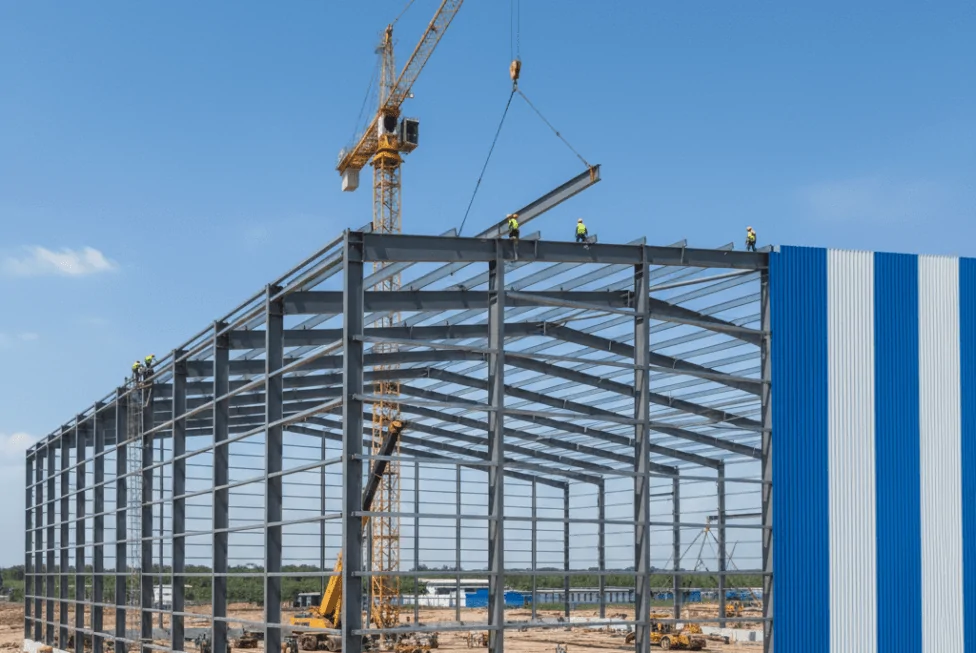
The PEB Industry (Pre-Engineered Building Industry) is rapidly transforming the industrial and commercial construction landscape across the globe. In India, the sector is witnessing remarkable growth due to its ability to deliver faster, flexible, cost-effective, and sustainable infrastructure solutions.
From large-scale warehouses to manufacturing plants, commercial complexes to multi-storey structures — the PEB Industry has emerged as the preferred construction choice for modern businesses seeking speed and efficiency.
Why the PEB Industry is Disrupting Traditional Construction
The rapid rise of the PEB Industry is driven by multiple advantages that outperform conventional construction methods.
✔️ Speed of Construction
PEB components are pre-designed and factory-manufactured, then assembled on-site. This reduces construction timelines by over 50%, enabling faster project delivery and quicker ROI.
✔️ Cost-Effective Infrastructure
Lower labor requirements, optimized material usage, and minimal wastage make the PEB Industry a highly economical solution for industries, logistics firms, and SMEs.
✔️ Design Flexibility
Pre-engineered buildings allow customization in:
-
Structure dimensions
-
Architectural aesthetics
-
Mezzanine floors
-
Future expansions
This makes PEB suitable for diverse industrial and commercial applications.
✔️ Eco-Friendly Construction
Sustainability is a key strength of the PEB Industry:
-
Recyclable steel components
-
Reduced on-site pollution
-
Energy-efficient insulation systems
These features align with global green building initiatives.
📈 Scope & Growth of the PEB Industry in India
India’s infrastructure boom, rapid urbanization, and industrial expansion are accelerating the growth of the PEB Industry.
🔹 Market Size
Industry reports project the Indian PEB Industry to reach USD 8–10 Billion by 2030, growing at a CAGR exceeding 10%.
🔹 Key Growth Drivers
-
Government infrastructure initiatives
-
Rising warehousing & logistics demand
-
SME industrial expansion
-
Smart city developments
-
Make-in-India manufacturing push
🔹 Major Application Areas
The PEB Industry caters to multiple infrastructure segments:
-
Warehouses & Logistics Parks
-
Cold Storage Units
-
Industrial Manufacturing Sheds
-
Multi-Storey Steel Buildings
-
Metro Stations & Airports
-
Commercial Complexes & Showrooms
🏭 Leading Players in the PEB Industry
Several companies are driving innovation and execution excellence in the Indian PEB Industry, including:
-
PEB Utkarsha
-
Tata BlueScope Steel
-
Kirby Building Systems
-
Zamil Steel
-
Interarch Building Products
These companies provide turnkey services — from design and engineering to fabrication and erection.
🧠 Innovations Reshaping the PEB Industry
Technological advancements are redefining the capabilities of the PEB Industry.
🔹 AI & BIM Integration
Artificial Intelligence and Building Information Modeling improve:
-
Design precision
-
Clash detection
-
Project timelines
🔹 Smart Materials
Modern insulation panels now offer:
-
Fire resistance
-
Thermal efficiency
-
Energy savings
🔹 Modular Expansion Systems
Future expansion provisions allow businesses to scale infrastructure without major reconstruction.
🔹 Advanced Protective Coatings
New-age coatings enhance corrosion resistance, improving building lifespan in harsh climates.
🔮 Future Trends
The future of the PEB Industry is technology-driven and sustainability-focused.
Key trends include:
-
Green building certifications
-
High-rise PEB structures
-
Export opportunities to developing nations
-
Digitally monitored smart buildings
-
Net-zero energy industrial facilities
The shift from traditional steel sheds to intelligent infrastructure marks the next evolution phase.
The Future Belongs to the PEB Industry
The PEB Industry represents the future of construction — efficient, scalable, and environmentally responsible. Its advantages in speed, cost savings, and flexibility make it a strategic investment for industrialists, developers, and infrastructure planners.
As India continues its infrastructure expansion, pre-engineered buildings will play a pivotal role in shaping modern industrial ecosystems.
Looking for customized, durable, and high-performance PEB solutions?
Partner with PEB Utkarsha — your trusted expert in innovative pre-engineered building construction.
📧 Email: Info.pebutkarsha@gmail.com
🌐 Website: https://pebutkarsha.co.in/
Transform your infrastructure vision into reality with future-ready PEB solutions.
❓ FAQs
What is the PEB Industry?
The PEB Industry refers to the Pre-Engineered Building sector that designs, manufactures, and installs steel structures that are factory-made and assembled on-site. It is widely used for industrial, commercial, and infrastructure projects.
Why is the PEB Industry growing rapidly in India?
The PEB Industry is growing due to faster construction timelines, cost savings, infrastructure development, and rising demand for warehouses, factories, and logistics parks across India.
How much time does PEB construction take?
Compared to traditional construction, projects in the PEB Industry can be completed up to 40–60% faster, depending on size and complexity.
Is PEB construction cost-effective?
Yes. The PEB Industry reduces overall project costs through optimized material usage, minimal wastage, reduced labor dependency, and faster project completion.
What types of buildings are made in the PEB Industry?
Common applications include:
-
Warehouses
-
Industrial sheds
-
Cold storages
-
Commercial showrooms
-
Multi-storey buildings
-
Airports & metro stations
Are pre-engineered buildings durable?
Structures developed by the PEB Industry are highly durable and designed to withstand wind loads, seismic activity, and harsh environmental conditions.
Is the PEB Industry eco-friendly?
Yes. The PEB Industry supports sustainable construction through recyclable steel, reduced site pollution, and energy-efficient insulation systems.
Can PEB structures be expanded in the future?
One major advantage of the PEB Industry is modular flexibility. Buildings can be easily expanded or modified without major structural changes.
What is the future scope of the PEB Industry?
The future of the PEB Industry is strong, driven by smart cities, industrial corridors, logistics growth, and government infrastructure initiatives.
Who should invest in PEB construction?
Industrialists, logistics companies, manufacturers, retailers, and infrastructure developers can benefit the most from solutions offered by the PEB Industry.